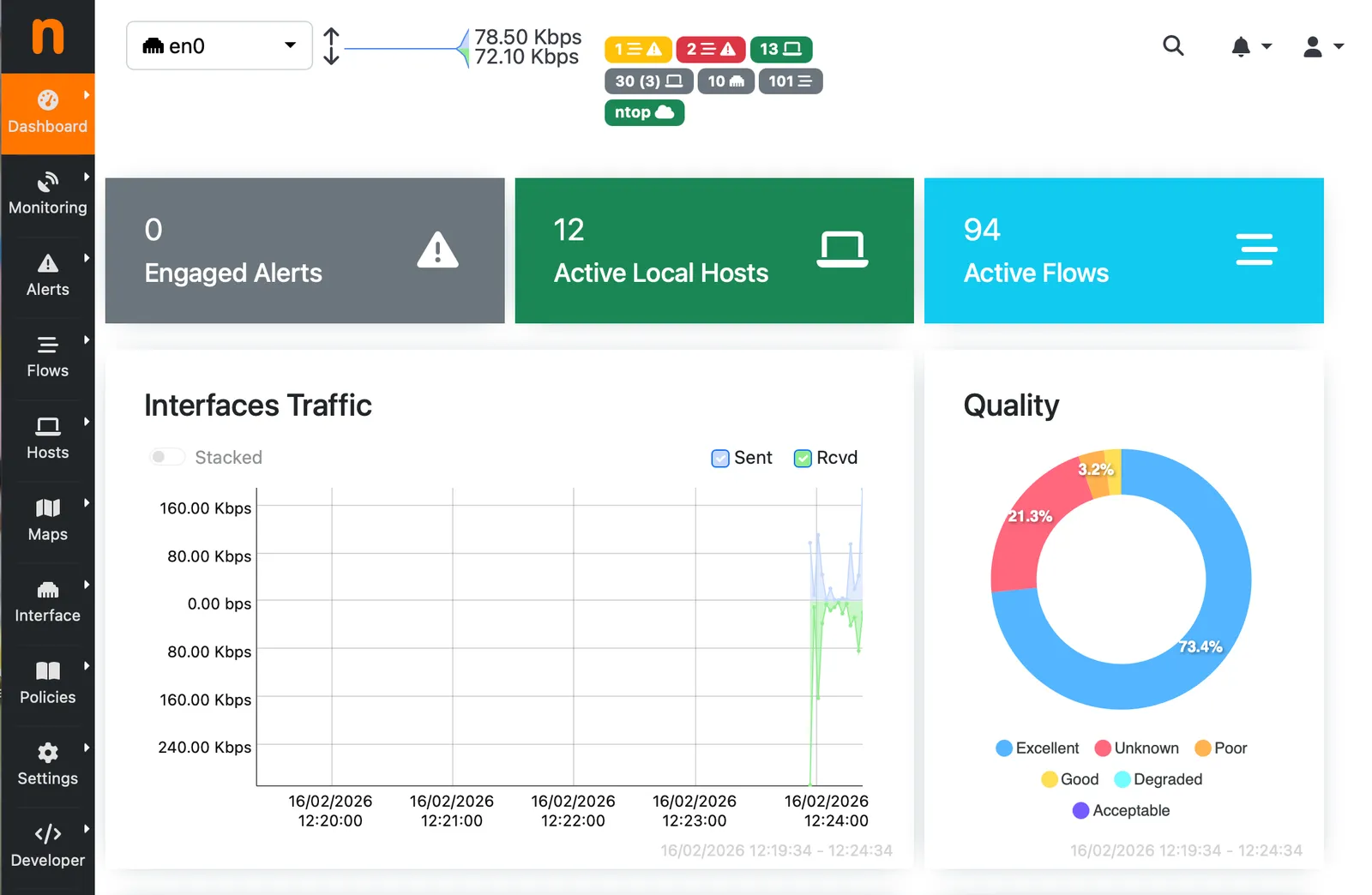
Modern network monitoring is no longer just about collecting data, it’s more about turning large volumes of time-series data into actionable insights. When enabling dump to ClickHouse, both for raw flow data…
ntopng has always supported multiple authentication methods to fit different environments: local accounts, LDAP, RADIUS, HTTP basic auth, etc. Now it also supports OpenID Connect (OIDC), bringing native Single Sign-on (SSO) support…
by Ivan Nardi One of the recurring challenges when embedding the nDPI library into a production application is answering a deceptively simple question: what is nDPI actually doing right now? You know…
Multi-Factor Authentication (MFA) is a security system that requires users to provide two or more verification factors to gain access to a resource such as an application, online account, or VPN. The…
A Large Language Model (LLM) is a type of artificial intelligence system that uses deep learning to understand, generate, and manipulate human language. Examples include Antropic Claude, OpenAI GPT, Meta Llama and…
As an ntopng developer, I often hear from users who are confused about the building blocks of network monitoring. Today, I’ll explain three fundamental concepts that will help you understand what your…
We’ve been quietly working on something that most users won’t notice at first glance — but will feel immediately. Starting with the latest dev ntopng version, the entire UI build pipeline has…
Transform network data into actionable infrastructure decisions with ntopng Introduction Every IT team faces the same challenge: how much network capacity is enough? Too little, and applications grind to a halt during…
Introduction When I first started investigating network security incidents, I felt overwhelmed by the complexity. Packets flying everywhere, mysterious connections, alerts I didn’t understand—sound familiar? Whether you’re an IT professional new to…
A slow DoS (Denial of Service) attack is a type of cyberattack designed to overwhelm a server or web application by exploiting protocol weaknesses—not through high-volume traffic, but by sending requests very…
High-speed networks continue to push the limits of software-based monitoring and security applications. As link speeds grow and traffic patterns become more complex, efficiently analyzing packets while maintaining per-flow state, for updating…
Flow deduplication is the process of identifying and removing duplicate flow records that appear in NetFlow/IPFIX data when the same traffic is monitored and exported by multiple observation points (typically network devices)…