

Intel 1 Gbit
Pricing in the ntop shop
- Supported Intel families: igb
- Hardware timestamps (on selected models)
- Link Speed: 1 Gbit
PF_RING ZC (Zero Copy) is for developers and operators who need packet RX and TX at 100+ Gbit line rate at any packet size. Choose it when kernel overhead is the bottleneck or when packets must pass between threads, applications or VMs without copies.
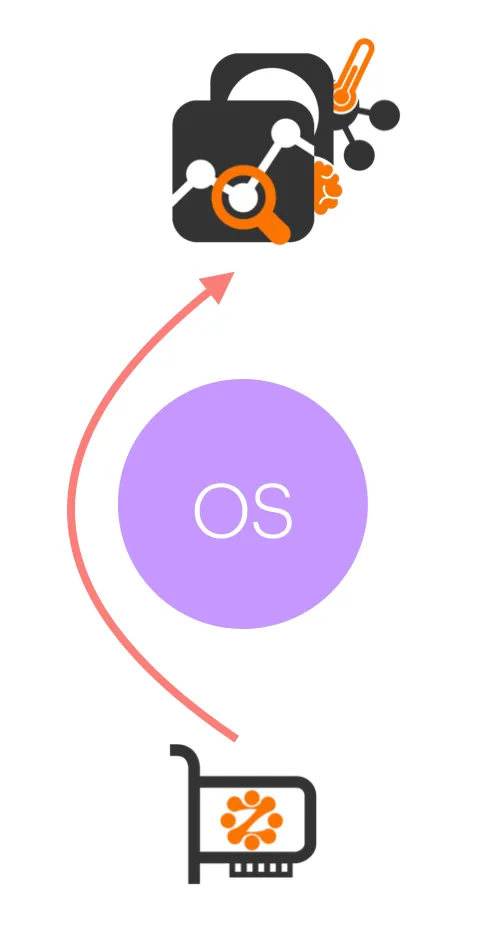
PF_RING ZC comes with a simple API able to create a complex application in a few lines of code. PF_RING includes a sample applicationzbalance_ipc implementing load-balancing using this API.
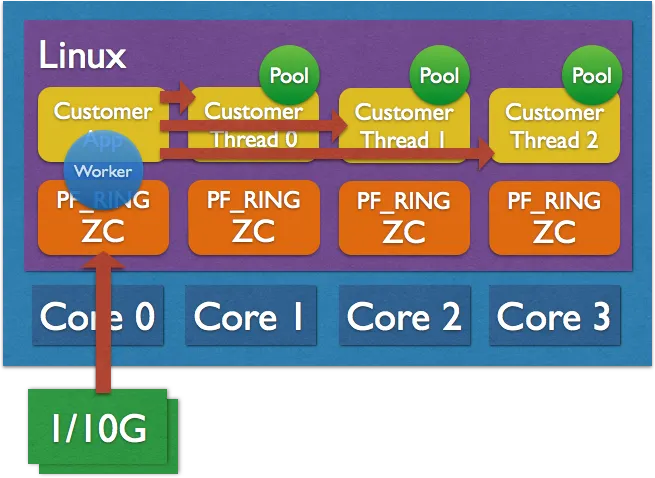
The following example shows how to create an aggregator + balancer application in 6 lines of code.
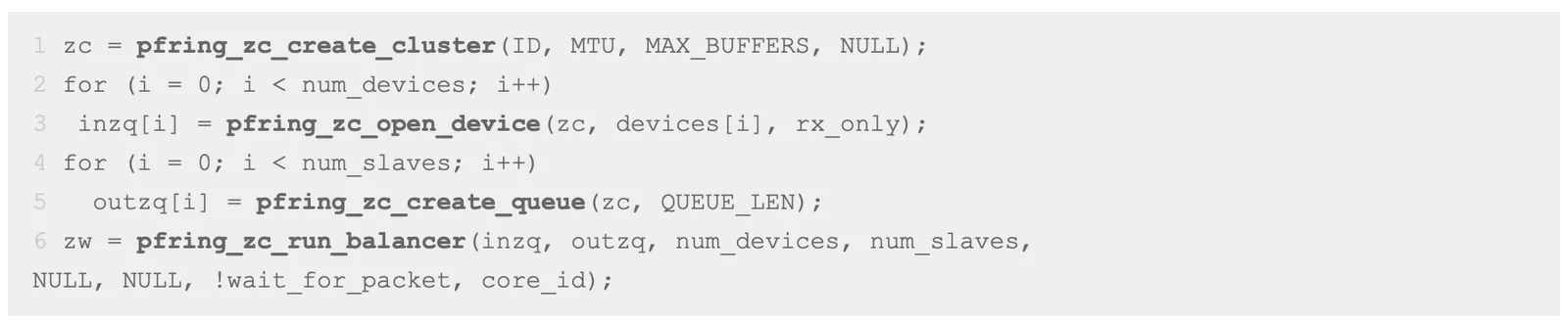
PF_RING ZC can perform zero copy operations across threads, applications and VMs. It is possible to balance in zero-copy packets across applications or implement packet fanout, which is merely sending the same packet (by reference) to multiple consumer applications, all in zero-copy, at line rate.
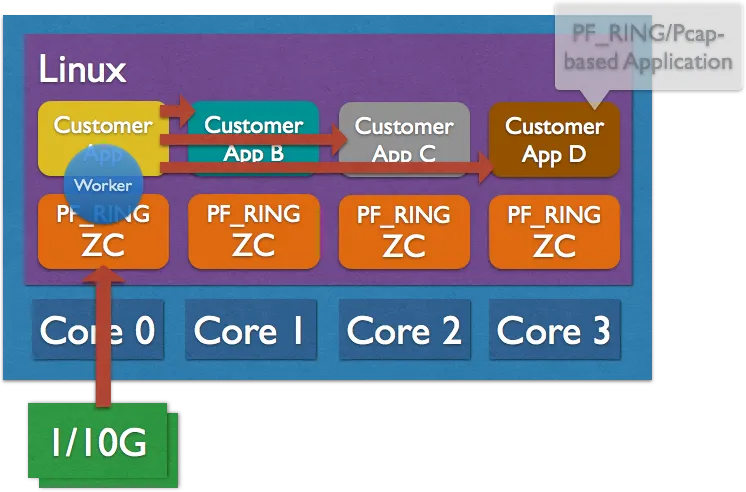
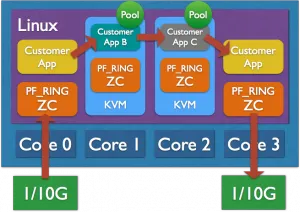
PF_RING ZC allows you to forward (both RX and TX) packets in zero-copy to KVM Virtual Machines without using techniques such as PCIe passthrough. Thanks to the dynamic creation of ZC devices on VMs, you can capture and send traffic in zero-copy from VMs without having to patch the KVM hypervisor code, or start KVM after your ZC devices have been created. In essence it is possible to capture traffic at line rate on KVM VMs using the same command you would use on a physical host, without changing a single line of code.
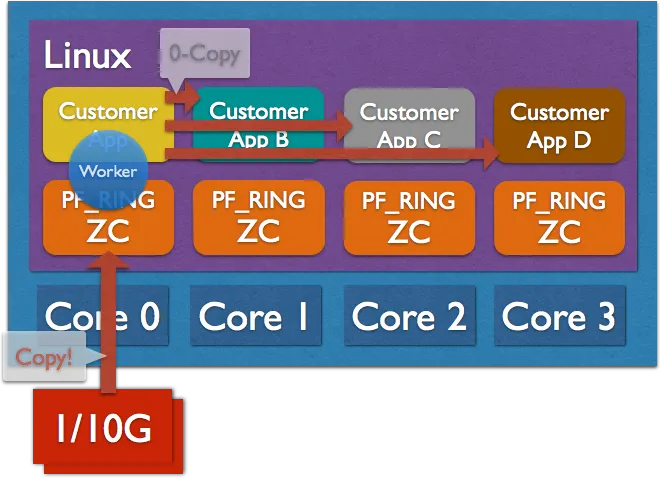
In PF_RING ZC you can use the zero-copy framework even with non-PF_RING aware drivers. This means that you can dispatch, process, originate, and inject packets into the zero-copy framework even though they have not been originated from ZC devices.
Once the packet has been copied (one-copy) to the ZC world, from then onwards the packet will always be processed in zero-copy during all his lifetime. For instance the zbalance_ipc demo application can read packet in 1-copy mode from a non-PF_RING aware device (e.g. a WiFI-device or a Broadcom NIC) and send them inside ZC for performing zero-copy operations with them.
Contrary to other kernel-bypass technologies, with PF_RING ZC you can decide at any time what packets received in kernel-bypass you want to inject into the standard Linux IP stack. PF_RING comes with an IP stack packet injection module called stack that allows you to select what packets received in kernel-bypass need to be injected to the standard IP stack. All you need to do is to open the device “stack:eth1” and send your packets for pushing them to the IP stack as if they were received from eth1.
Same criteria for each option: role, when to choose it, limits and cost.
Try PF_RING ZC on your own traffic.
x86 64-bit platforms are supported (Intel and AMD)
Did you already install the software?
InstallSelect the model. Different models unlock different adapters and capacity. Check the comparison table.
Pricing in the ntop shop
Pricing in the ntop shop
Pricing in the ntop shop
PF_RING ZC comes with a simple API able to create a complex application in a few lines of code. PF_RING includes a sample applicationzbalance_ipc implementing load-balancing using this API.
The following example shows how to create an aggregator + balancer application in 6 lines of code.
PF_RING ZC can perform zero copy operations across threads, applications and VMs. It is possible to balance in zero-copy packets across applications or implement packet fanout, which is merely sending the same packet (by reference) to multiple consumer applications, all in zero-copy, at line rate.
PF_RING ZC allows you to forward (both RX and TX) packets in zero-copy to KVM Virtual Machines without using techniques such as PCIe passthrough. Thanks to the dynamic creation of ZC devices on VMs, you can capture and send traffic in zero-copy from VMs without having to patch the KVM hypervisor code, or start KVM after your ZC devices have been created. In essence it is possible to capture traffic at line rate on KVM VMs using the same command you would use on a physical host, without changing a single line of code.
In PF_RING ZC you can use the zero-copy framework even with non-PF_RING aware drivers. This means that you can dispatch, process, originate, and inject packets into the zero-copy framework even though they have not been originated from ZC devices.
Once the packet has been copied (one-copy) to the ZC world, from then onwards the packet will always be processed in zero-copy during all his lifetime. For instance the zbalance_ipc demo application can read packet in 1-copy mode from a non-PF_RING aware device (e.g. a WiFI-device or a Broadcom NIC) and send them inside ZC for performing zero-copy operations with them.
Contrary to other kernel-bypass technologies, with PF_RING ZC you can decide at any time what packets received in kernel-bypass you want to inject into the standard Linux IP stack. PF_RING comes with an IP stack packet injection module called stack that allows you to select what packets received in kernel-bypass need to be injected to the standard IP stack. All you need to do is to open the device “stack:eth1” and send your packets for pushing them to the IP stack as if they were received from eth1.
Download the free Community edition, compare editions and buy in the shop, or talk to the ntop team about your requirements.